Know the material.
Sound clear under pressure.

Oral Exam Method gives you a repeatable structure for starting, controlling, and recovering spoken answers.

Built for students whose answers become too fast, too wide, or unclear when they speak.

Oral Exam Method — Stop Rambling, The Oral Exam OS, and The Mock Oral Workbook
The real problem

Knowing the material is not the same as delivering it clearly.

You can know the concept, the main points, and the examples — and still sound unclear once the examiner asks the question.

You begin before the structure is there.

You keep adding detail because stopping feels dangerous.

The useful part of the answer arrives too late.

That is not just a knowledge problem.
It is a spoken-structure problem.

Weak starts

You start before the answer has a frame.

Loose structure

You list facts before showing priority.

Panic recovery

You keep talking because silence feels unsafe.

Do not try to sound more complete first.

Make the answer easier to follow first.

More detail does not help if the examiner cannot hear the structure.

How the method works

The method gives your answer a spine.

Instead of trying to sound smart under pressure, you follow a structure that keeps the answer clear.

01

Start with a frame.

Give the examiner structure before detail.

02

Make the priority visible.

Do not make the examiner search for the main point.

03

Add detail in layers.

More detail will not make the answer stronger if the frame is unclear.

04

Recover order before detail.

When your mind goes blank, reset the structure before adding more content.

05

Close before the answer dissolves.

Stop when the useful answer has landed.

Ready to choose the tool that fits your problem?

Why structure matters

Same knowledge. Different score.

Two students can know the same material and receive completely different marks.

Not because one is smarter.
Because one controls the answer.

In an oral exam, examiners are not only listening for correct facts. They are listening for whether you can organise those facts under pressure.

Example question

Why can dehydration lead to fainting?

Weak answer

“Dehydration means the body does not have enough water, and then blood pressure can be lower, and people can feel dizzy.”

Controlled answer

“The key mechanism is reduced circulating volume. Less fluid can reduce venous return, lower cardiac output and blood pressure, and reduce cerebral perfusion. If cerebral perfusion drops enough, the person may faint.”

What changed

The answer did not become much bigger.
It became easier to assess.

Weak answer
  • lists facts
  • starts generally
  • adds points without order
  • examiner has to organise it
Controlled answer
  • frames the mechanism
  • starts with the danger
  • links cause to consequence
  • student controls the structure

The controlled answer does not use much more knowledge.
It uses better order.

Failure diagnosis

Weak answers rarely fail everywhere.
They usually break at one point.

Most students only notice the global feeling:

  • The answer felt weak.
  • The examiner looked unconvinced.
  • I lost the thread.

But the useful question is more specific:

Where did the answer actually break?

  • OpeningNo frame.
  • PriorityMain point arrives too late.
  • ExpansionAnswer widens before it is stable.
  • Follow-upRedirect feels like failure.
  • Partial knowledgeUncertainty turns into filler.
  • EndingAnswer trails off instead of closing.

Find the break point.
Then repair that point.

The full system

The first sentence is only the beginning.

Most students prepare for the first answer.

The Oral Exam OS prepares for the full cycle: follow-ups, silence, narrowing, partial knowledge, time pressure, and recovery.

Shape → Frame → Prioritise → Expand → Redirect → Stabilise → Close → Review

Start

Shape → Frame → Prioritise

Build

Expand in controlled layers

Recover

Redirect → Stabilise

Finish

Close → Review

Practice

Understanding the method is not enough.
You need to speak it.

The workbook is not more reading.

It turns the method into a repeatable practice loop.

  1. 01Speak.
  2. 02Score.
  3. 03Find the first break point.
  4. 04Fix one thing.
  5. 05Repeat once.

Score structure first.

Knowledge gaps can be studied later.

Weak answer shape has to be trained out loud.

Across fields

The topic changes.
The break pattern does not.

The same control pattern works across oral exams, vivas, presentations, and defences.

  • Medicinemechanism first
  • Lawcriteria first
  • Businesstrade-off first
  • Thesis defencemethod-fit first
  • STEMprinciple first
  • Humanitiescategories first

Do not copy the subject.
Copy the control sequence.

This does not replace studying.

It helps you organise and deliver what you already know more clearly under pressure.

Choose your starting point

Choose the product that fits your problem.

Use the smallest product that solves today's problem. Use the full system when you need the full oral-exam cycle.

Quick fix

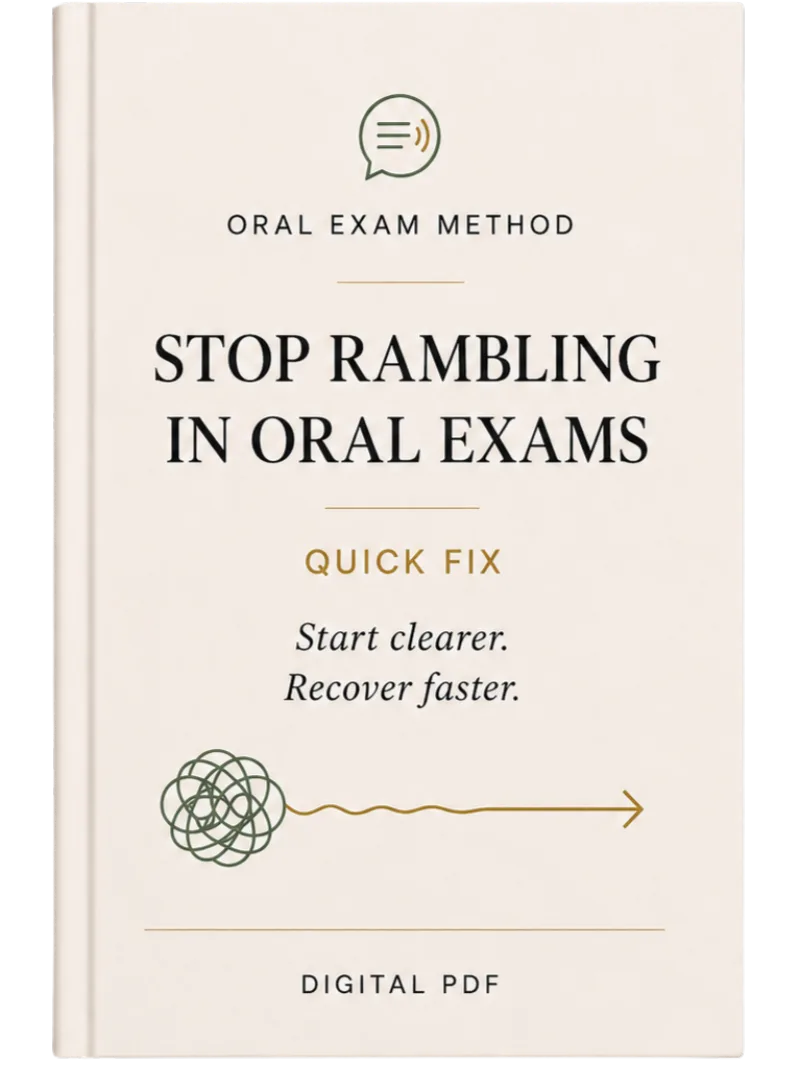
Stop Rambling in Oral Exams

€24

Best if your exam is soon.

A quick structure system for students who need clearer answers fast.

  • Safe Start lines
  • 5-Part Answer Spine
  • Recovery lines
  • 15-minute oral drill
Best value

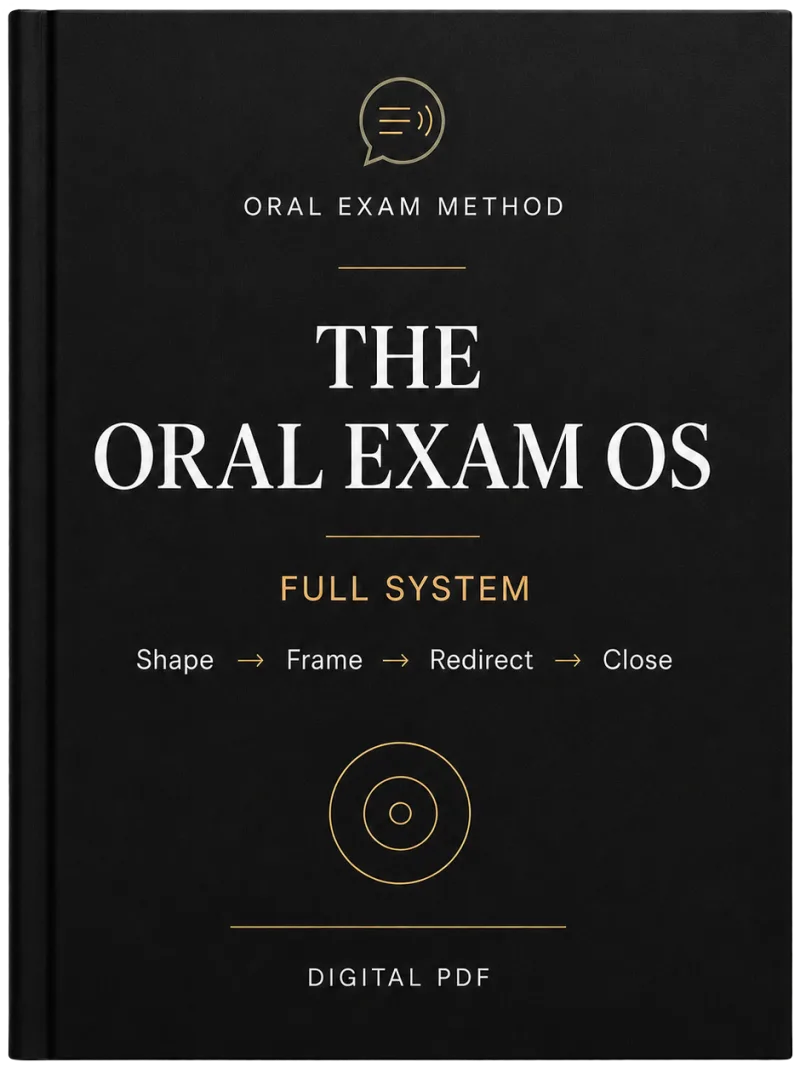
The Oral Exam OS

€59 launch price

The full system for turning knowledge into clear spoken answers.

Includes the €19 Mock Oral Workbook.

  • answer-cycle system
  • break-point diagnosis
  • rescue tools for weak moments
  • worked examples
  • Mock Oral Workbook included
Practice only

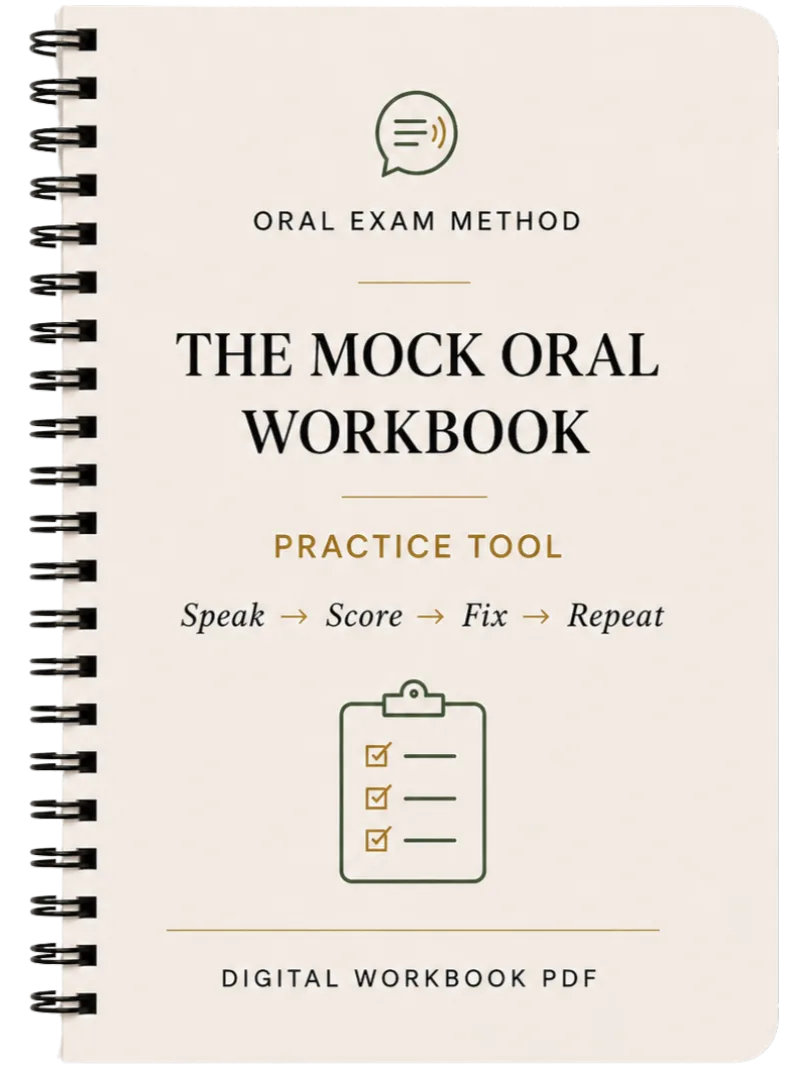
Mock Oral Workbook

€19

For drills, scorecards, and mock oral practice.

Included free with The Oral Exam OS.

  • 15-minute mock oral setup
  • answer scorecards
  • cross-field prompt bank
  • drill pages
  • Speak → Score → Fix → Repeat loop
Best value

Practice alone is useful.
Method + practice is stronger.

The Oral Exam OS gives you the full answer-control system.

The Mock Oral Workbook turns that system into spoken repetition.

That is why The Oral Exam OS includes the €19 Mock Oral Workbook.

How purchase works

Choose your product. Download the PDFs. Start practising out loud.

01

Choose your product

Pick the quick fix, the full system, or the workbook.

02

Complete checkout

Use the secure checkout to purchase the digital product.

03

Download instantly

After purchase, you receive the PDF files digitally.

04

Practise out loud

Read the method, use the drills, score your answers, and repeat.

The checkout is simple: choose your product, complete payment, and download the PDFs.

FAQ

Questions before you choose

Stop sounding less prepared than you are.

Choose the quick fix, the full system, or the practice workbook.